Major projects announcement hampered by red tape, lack of pipelines: Critics
Canada to fast-track five projects across Canada as part of Liberals' nation-building efforts.
Bryan Passifiume, Toronto Sun
Read in the Toronto Sun.
OTTAWA — Reaction to the prime minister’s major projects announcement Thursday was wide ranging.
John Rustad, leader of B.C.’s Opposition Conservatives, told the Toronto Sun that two of the announced projects in his province — Phase 2 of the LNG Canada facility in Kitimat and the Red Chris mine in northern B.C. — were already approved and underway by the time Mark Carney made his announcement.
“It’s great that they’re on the list in terms of what he’s recognizing, but what’s really needed for British Columbia are new pipes, more LNG capacity and quite frankly for Canada to get oil to our coasts,” he said.
Despite his province’s vast natural gas reserves, Canada still sells it to the Americans — like our crude oil — at steep discounts.
“It’s great that we have LNG Canada and that it’s going forward with Phase 2, but it took 15 years to get that one major LNG project going,” he said.
“What’s needed is the political will to actually get our gas to coast so we can stop selling our gas at an 80% discount to the Americans.”
In a statement from his office, Ontario Premier Doug Ford said that with U.S. President Donald Trump taking aim at Canada’s economy, it’s never been more important to build fast.
“The federal government needs to urgently join Ontario in speeding up approvals for critical mineral projects, including by building all-seasons roads to the Ring of Fire,” the statement said, pointing out that the project would create more than 70,000 new jobs and add $22 billion to Canada’s economy.
“As a first step, we need the federal government to end its regional impact assessment, which is only duplicating work being done by First Nations partners and slowing down construction.”
Candace Laing, president and CEO of the Canadian Chamber of Commerce, welcomed the news — describing the projects as “building blocks” for bolstering Canada’s economy, but adding that they won’t attractor investors if the federal government doesn’t lift regulatory hurdles.
“Expecting companies to pursue such projects is unrealistic while they face an oil and gas emissions cap, ‘green-hushing’ provisions under the Competition Act, permitting purgatory for basic infrastructure that doesn’t meet the ‘major project’ threshold and other barriers to economic expansion and resource development,” she said.
“To attract private investment and advance critical energy infrastructure, the federal government must remove these hurdles.”
Franco Terrazzano, federal director of the Canadian Taxpayers Federation, called out the federal government for not identifying the real problem hamstringing large projects: Onerous regulation.
“The problem is not a lack of talking and new announcements … the problem is the lack of action on cutting taxes and red tape to grow the economy and attract investment,” he said.
“The best way to grow our economy and attract investment in all sectors is for the government to cut taxes and red tape.”
Political strategist and former press secretary Shon Amayev said that despite promises of speedy approvals through the new Major Projects Office, delays are certain and do little to address the problems of today.
“Meanwhile, Statistics Canada reports 66,000 jobs lost in August alone, while Liberal inaction and red tape continue to stifle growth and doom pipeline projects,” he said.
“It’s time to call Carney’s ‘nation-building’ for what it is: A headline-grabbing mirage and desperate attempt to boost approval ratings.”
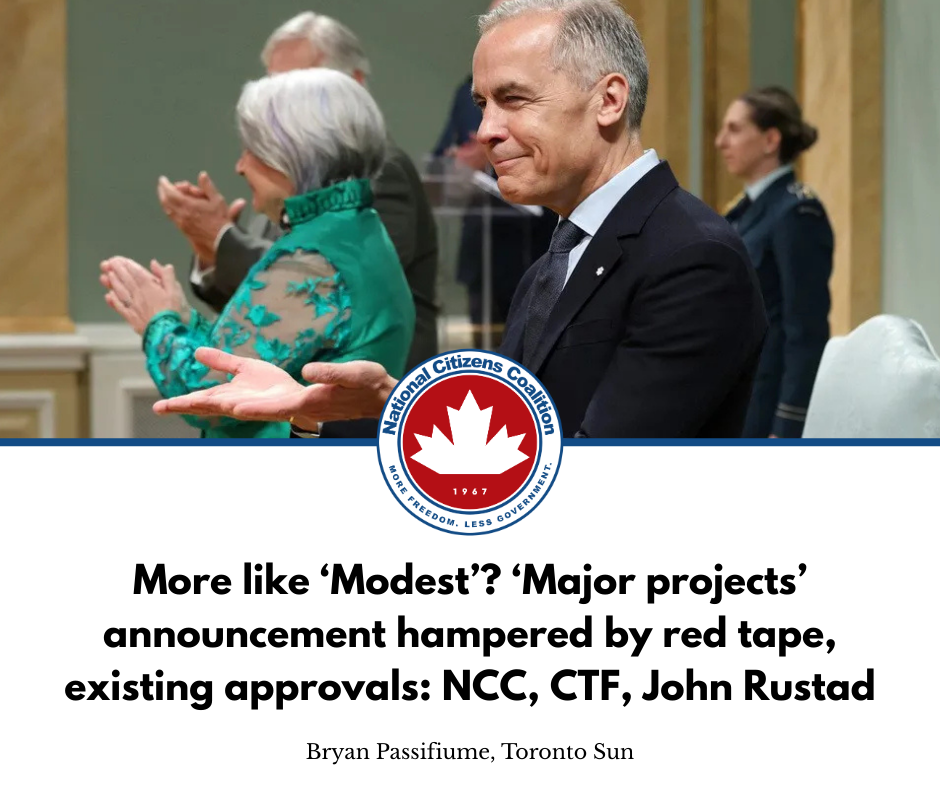
Alex Brown, a director with the National Citizens Coalition, lamented the lack of pipelines in the announcements.
“These are non-controversial projects already getting the go-ahead that appear only to be receiving a slightly easier ride,” he said.
“This may represent change by the low standards of this modern iteration of the Liberal Party of Canada, but make no mistake — this announcement appears to be predominantly symbolic and as politically calculating and cynical as industry leaders have feared.”