New Management, Same Liberal Crusades
EV adoption requires honesty over fantasy, and offloading industrial emissions to China while pushing Canadians to buy Chinese products is carbon laundering presented as a form of green patriotism.
By Geoff Russ
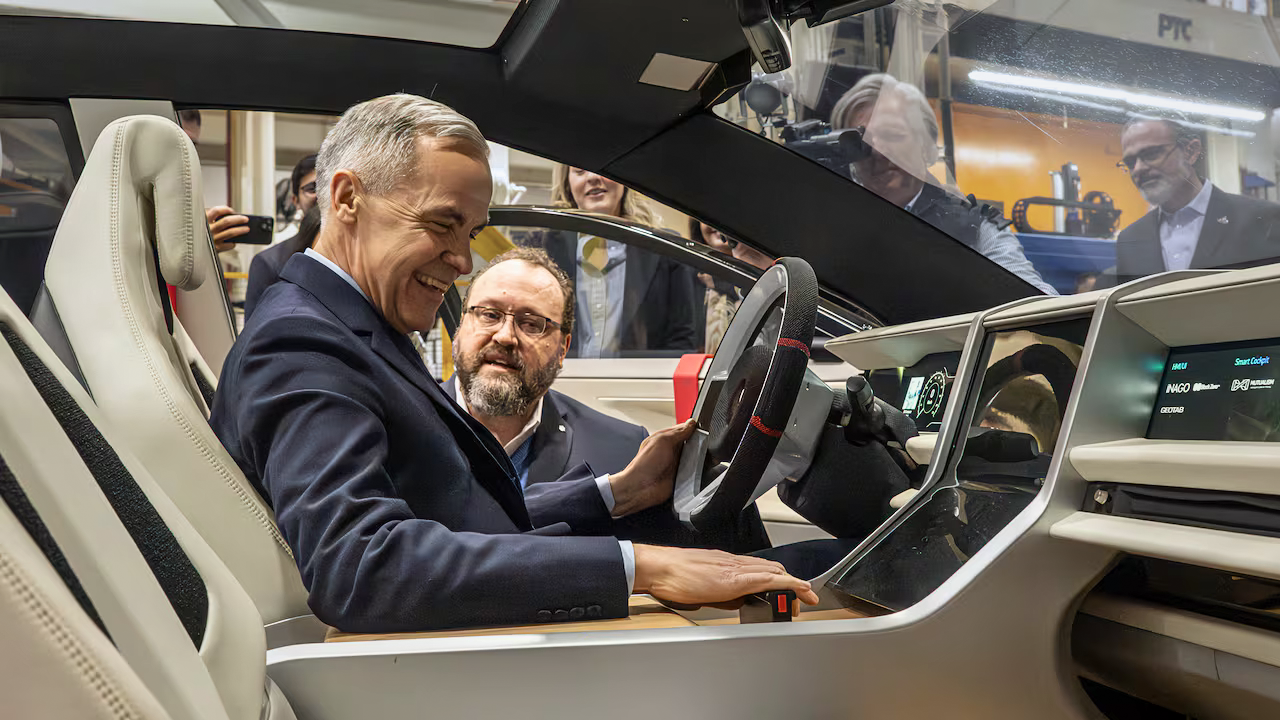
Mark Carney’s pitch to voters was that he, not the Opposition, was the needed break from the unpopular government.
After a year, voters are still waiting for a real change in thinking. On immigration and electric vehicles alike, the instincts that guided the Trudeau years appear to simply be operating under new management. They still believe in a top-down approach to the bread-and-butter aspects of life, but with cosmetic changes to soften the backlash.
On immigration, Carney’s government promised to restore “balance and control”, but they are still planning for upwards of 450,000 new permanent residents by the end of 2026.
New one-time initiatives are being pushed out to transition temporary workers into future citizens, through an automated, online citizenship test that takes less effort and has less meaning than buying a new phone. This is a repackaging of the same massive intake into a country that has turned against mass immigration.
The same pattern is happening with electric vehicles, an obsession of Trudeau’s that he sought to impose upon the people of Canada with sales mandates and huge subsidies for EV manufacturing.
Carney is offering fresh tailpipe targets, new incentives for purchasing, further spending on charging, and more industrial subsidies and bureaucracy. This is a softer coercion, and a form of meddling, but coercion nonetheless.
It also remains detached from reality. EVs are an expensive purchase for ordinary people. The Tesla Model Y costs $64,000 retail in 2025, and the Model 3 is $68,000. The Volkswagen ID.4 retails at $49,000, and a fresh Ford Mustang Mach-E goes for almost $56,000.
Traditional gas-powered cars come out to about $30,000. This is the problem with EVs: they are simply out of reach for middle-income households in this economy.
This is the vehicular privilege of high-income earners, sustained by subsidies from Ottawa. When those subsidies were scaled back, EV sales fell off dramatically last year.
There has been no consumer revolution in Canada with EVs, only a subsidy program on wheels that is running off the road.
The answer is always the same: more subsidies, regulation, and forced importation. China is a major player here, producing cheaper EVs than European or American models that are treated like a magic solution to emissions.
Whatever emissions are reduced by the mass production of cheap Chinese EVs come with their own set of industrial pollution through their manufacturing.
The Massachusetts Institute of Technology (MIT) has found that battery-electric vehicles cause more emissions up front compared to gas-powered cars. Battery manufacturing is energy-intensive, and mineral processing is emissions-intensive.
EV adoption requires honesty over fantasy, and offloading industrial emissions to China while pushing Canadians to buy Chinese products is carbon laundering presented as a form of green patriotism.
Motorists do not deserve to be dragooned into this regime. Canada has oil and gas, and the ability to produce and ship energy that it can control and expand. Gas-powered cars are familiar and affordable for Canadian families.
Those with the means have every right to buy and drive EVs, but that should be a personal choice. It should not be an ideological mandate underwritten by taxpayers who cannot afford an EV in the first place.
We sacrifice even more of our economic freedom, consumer choice, and fiscal capacity when we try to reengineer the auto market. It is high time to end this EV crusade and let Canadians drive what they want, and on their terms.
Geoff Russ is a policy manager in the resource sector and contributor to several national publications across Canada, the United States, and Australia. Read his work in Without Diminishment, the National Post, the Spectator Australia, and Modern Age.
There's no solving for Canada's cost of living crisis -- or tariff crisis -- without growing Canada's resource economy, and restrictions on our energy sector have proven themselves to be just another tax on working families. Help us advocate on your behalf, and on behalf of our Great Canadian energy producers and innovators.
Donate to the NCC's Energy Affordability Now campaign.